
The most reliable way to improve amusement ride safety and prevent accidents is a five-layer system: safe design, correct installation, daily pre-operation checks, disciplined operator procedures, and a rehearsed emergency response. Get those five layers right, and you remove the conditions that cause nearly every preventable incident.
Here’s the uncomfortable truth most operators learn too late: industry safety data points to two leading causes behind almost every serious ride incident, and both are mechanical failure and operator error. Neither is bad luck. Both are controllable with procedure.
You already know a single accident can close your venue, void your insurance, and erase a season of ticket revenue. What you may not have is a clear, factory-built playbook for running a ride safely day after day, especially in markets where the nearest qualified inspector is a flight away. That’s what this guide delivers: the exact operating procedures we train Swawa operators to follow, written for venues across Central Asia, the Middle East, Africa, Southeast Asia, and Latin America.
As the official global brand of Zhongshan Amusement Equipment Industrial Park, we’ve delivered 100+ rides to 20+ countries. We know exactly how these machines fail, and which habits stop them. Let’s walk through the system layer by layer.
Key Takeaways
– Most preventable ride incidents trace to two controllable causes: mechanical failure and operator error.
– A five-layer safety system (design, installation, daily checks, operator SOPs, emergency response) covers the full risk chain.
– A daily pre-operation safety check takes roughly 20 to 30 minutes per ride and stops most issues before the gates open.
– The single most dangerous operator habit is bypassing a fault to keep the ride running. Stop and call support instead.
– Documented training, ride logs, and a productized Spare Parts Kit turn safety from a hope into a system insurers and authorities accept.
What Actually Causes Amusement Ride Accidents?
Most amusement ride accidents are not freak events. They cluster around a few repeatable causes, and naming them is the first step to preventing them.
Industry reports and engineering investigations consistently point to two leading factors. The first is mechanical failure: a worn restraint latch, a fatigued structural weld, a hydraulic line past its service life, or a control fault left unaddressed. The second is operator error: dispatching with an unlatched lap bar, restarting a ride after a fault, or stopping the cycle at the wrong moment.
A third factor sits with the rider: ignoring height or health restrictions, standing during motion, or defeating a restraint. Clear signage and firm operator enforcement control most of this.
There is a fourth cause that rarely makes the headlines but quietly drives risk in emerging markets: deferred repairs. When a spare part is six weeks away by sea freight, the temptation to “run it one more weekend” is enormous. That single decision converts a maintenance issue into a safety incident.
How common are the consequences? Across large markets, published safety data describes on the order of a few fatalities per year and tens of thousands of ride-related injuries annually, the majority minor. In 2025 alone, widely reported incidents included a structural collapse on a wheel ride and a group of riders left stranded in mid-air for over an hour after a control-signal fault. The specifics differ, but the root causes repeat: a missed inspection, a bypassed fault, a step skipped under time pressure.
The lesson is not fear. It is procedure. Every cause above is addressable with the layered system below.
Want a partner who treats after-sales as a safety system, not a sales afterthought? See how Swawa’s global installation and after-sales support works.
The 5-Layer Amusement Ride Safety System
Think of ride safety as five layers stacked on top of each other. A failure in one layer should be caught by the next. When operators treat safety as scattered tips, gaps open. When they treat it as a system, the gaps close.
- Safe design and certification. The ride must be engineered and tested to a recognized standard before it ever reaches your site. This is the manufacturer’s job, and you should demand the paperwork.
- Correct installation and commissioning. A safe ride installed wrong is an unsafe ride. Foundation, leveling, electrical configuration, and a full test cycle all matter.
- Daily pre-operation checks. A short, disciplined inspection before the gates open, every single day.
- Operator standard operating procedures (SOPs). The rules the operator follows during every cycle, every dispatch.
- Emergency and evacuation response. A rehearsed plan for the moment something goes wrong.
Layers 1 and 2 are mostly settled before opening day. Layers 3, 4, and 5 are where your daily discipline lives. We’ll spend the rest of this guide there, because that’s where operators actually win or lose on amusement ride safety.
Layer 1 and 2: Design and Installation You Can Verify
You can’t inspect your way out of a badly designed ride. Safe operation starts with equipment built and tested to a recognized standard such as the ASTM F24 family, which covers ride design, manufacture, operation, and inspection. The ASTM design practice for amusement rides is the global reference point, and reputable manufacturers test against it.
Ask any supplier for three things before you sign: design and load-test documentation, an electrical configuration matched to your local voltage (220V or 380V), and an installation manual with torque values and safety limits. Every Swawa ride ships after pre-shipment load testing, pre-wired for your market’s voltage, with the manuals that make correct installation possible. Skip this verification, and Layers 3 through 5 are built on sand.
Daily Pre-Operation Safety Procedures
Before a single guest boards, the ride must pass a daily pre-operation safety check. Done properly, it takes roughly 20 to 30 minutes per ride and is the highest-return 30 minutes in your operating day.
Run the same sequence every morning, in the same order, logged on paper or in an app:
- Power-on and control test. Confirm the main control panel responds correctly and all indicator lights read normal.
- Emergency stop test. Physically test every e-stop button, at the operator station and any secondary locations. This is non-negotiable.
- Restraint cycle. Lock and release every lap bar, harness, and seat belt. Feel for play, listen for the latch.
- Empty test run. Run at least one full cycle with no riders. Listen for unusual noise, vibration, or heat from drive motors and gearboxes.
- Site walk. Check that queue barriers, the loading platform, and the exclusion zone are clear of trip hazards and obstacles, and that height and restriction signage is visible.
- Weather check. For outdoor rides, confirm wind, rain, and temperature are within the manufacturer’s stated limits.
Consider Aibek, who operates a compact swing ride in a shopping mall in Central Asia. One morning his empty test run produced a faint knock from the drive housing that was not there the day before. The ride looked fine. Under time pressure, plenty of operators would have opened anyway. Aibek followed the rule, held the ride closed, and called support. The cause was an early bearing fault that, left for the weekend crowd, could have failed under full load. A 30-minute check protected dozens of riders and his license.
This daily safety check is the front line, but it is not the whole maintenance story. Bearings, lubrication, and wear-part schedules belong to a deeper cadence. For that layer, follow our daily amusement ride maintenance routine, which pairs with this safety guide as a complete operating system.
The “Do Not Open” Red Lines
Train every operator on the conditions that force the ride to stay closed, with no exceptions: a failed e-stop test, a restraint that does not latch firmly, any new noise or vibration, weather outside limits, or a control fault the manual does not let you clear. A ride that stays closed for an hour costs you tickets. A ride that opens unsafe can cost you everything.
Operator Standard Operating Procedures During Operation
Once the gates open, amusement ride safety lives in the operator’s hands. A clear set of standard operating procedures (SOPs) turns a busy, distracted shift into a repeatable, safe routine.
These are the operating rules we train into every Swawa operator:
- One trained operator owns each dispatch. The person at the controls is qualified, signed off, and not multitasking on something else.
- Never leave the control booth live. If the operator steps away, power down or apply lockout/tagout (LOTO) so the ride cannot be started accidentally.
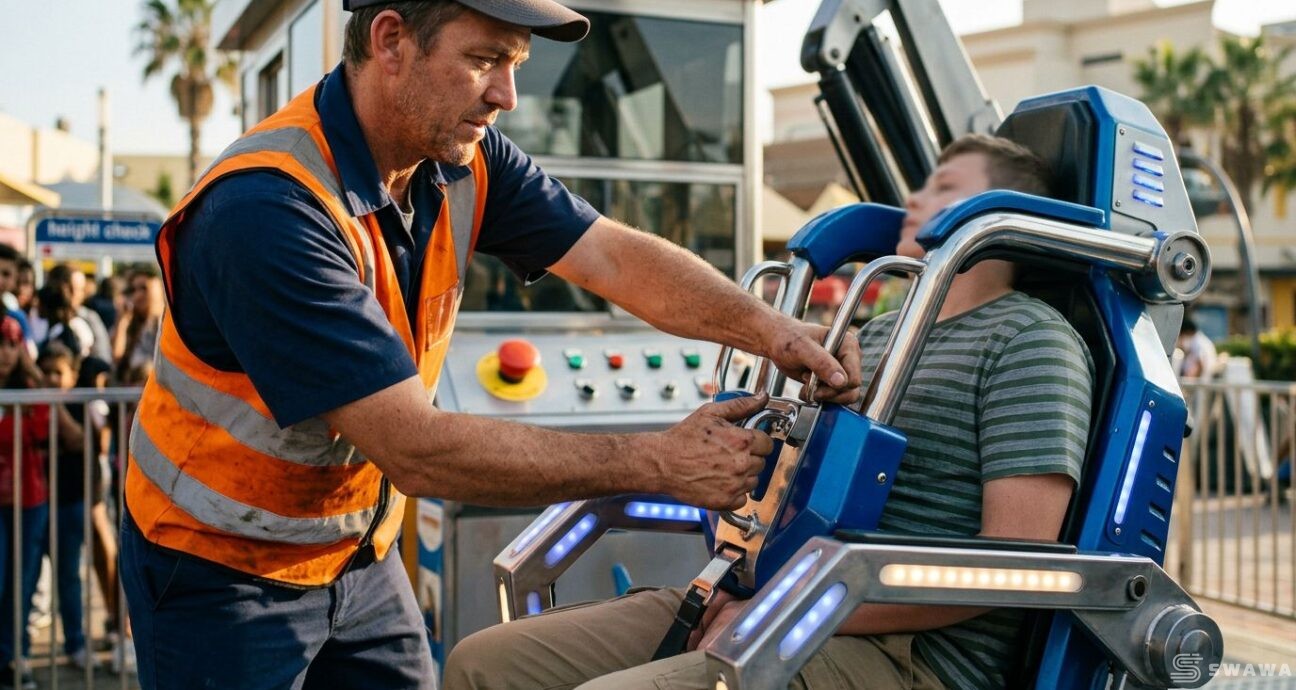
- Verify every restraint, every cycle. Walk the train and physically check each lap bar, harness, and belt before dispatch. Not a glance, a touch.
- Enforce restrictions without exception. Height, weight, and health rules apply to everyone, including the owner’s family and VIP guests. Make signage clear and visible.
- Never manual-bypass a fault. If the ride stops or shows an error, do not force it past the safety system. Stop, secure the ride, and call technical support.
That last rule is the one that saves lives. The safety system stopped the ride for a reason. Bypassing it to clear a queue is the operator error that turns a minor fault into a serious accident.
Picture Mariam, a venue manager at a family entertainment center in the Gulf. Her restraint-check protocol is strict: touch every harness, every cycle, no shortcuts. On a packed holiday afternoon, her operator found one shoulder harness that latched audibly but had developed play in the locking mechanism. Because the check was physical, not visual, they caught it, pulled that seat from service, and ran the rest. A loose restraint on a spinning ride is exactly the failure mode that makes the news. Procedure caught what a glance would have missed.
Ready to build operations on equipment designed for this discipline? Talk to a Swawa engineer about a ride and a safety setup matched to your venue.
Emergency and Evacuation Procedures
Sooner or later, a ride will stop mid-cycle. A power dip, a sensor fault, a precautionary trip. What separates a safe venue from a dangerous one is whether the operator follows a rehearsed plan or improvises.
Train this exact sequence, and drill it regularly:
- Secure the ride. Hit the emergency stop or confirm the ride is in a safe, stationary state.
- Reassure the riders. Calm, clear communication. Tell guests they are safe and that staff are handling it. Panic causes more injuries than the stoppage itself.
- Call maintenance and the manager. Report the fault immediately and clearly. Do not attempt a restart on an unresolved fault.
- Evacuate only by protocol. If a safe restart is not possible, follow the manufacturer’s evacuation procedure to bring riders down in a controlled way, never improvised climbing or jumping.
Just as important is what operators must never do: never restart on an active fault, never let guests self-evacuate, and never leave riders without communication. For venues with non-native or seasonal staff, post short, plain-language scripts at the control station so the right words are always within reach.
A rehearsed emergency response is also a documentation event. Every stoppage, near-miss, and evacuation should be logged. Those records protect you in any later investigation and reveal patterns before they become incidents.
Operator Training, Certification, and Documentation
A safety system is only as strong as the people running it. Documented operator training is required by ride manufacturers, insurers, and amusement-ride authorities alike, and training records are critical evidence if an incident is ever investigated.
Only trained, signed-off staff should run a ride. Build your training program around four pillars:
- The ride’s SOP: dispatch sequence, restraint checks, and controls.
- Emergency actions: e-stop, evacuation protocol, and how to call for help.
- Restraint and restriction enforcement: the rules and how to apply them firmly.
- Guest medical basics: what to do if a rider feels unwell.
Then keep records. A simple ride log capturing daily checks, faults, near-misses, and training sign-offs is the backbone of a defensible safety program. The relevant standards are worth knowing too: the ASTM F770 practice covers ownership, operation, maintenance, and inspection, while the broader ASTM F24 committee standards and the safety guidelines published by IAAPA give your team an authoritative reference.
Swawa supports this layer directly. We provide pre-commissioning operator training covering safety, daily operation, and basic maintenance, so your team is ready before opening day rather than learning on live riders. If a procedure is unclear, our buyers can also check our FAQ for overseas operators or reach the support team.
How a Factory-Direct Partner Reduces Accident Risk
Here is what most safety guides leave out: who you buy from changes your risk profile. Buy from a trader who vanishes after the wire transfer, and Layers 1 through 5 become your problem alone. Buy factory-direct, and the manufacturer stays in the loop.
A factory partner reduces accident risk in concrete ways:
- Manuals with real numbers. Torque values, lubrication types, and safety limits remove guesswork. Guesswork is how installation and maintenance errors creep in.
- A productized Spare Parts Kit. Every Swawa ride ships with a model-specific Spare Parts Kit sized for roughly 12 months of operation, covering about 95% of wear scenarios. The part is on your shelf, so the “run it broken” decision never has to happen.
- A 24-hour Video Support Center. When an operator hits a fault they cannot clear, a real engineer is on the line, often before a small problem becomes a dangerous one.
- Belt-and-Road-native engineering. Multi-voltage wiring (220V/380V) and climate-adapted materials remove the electrical and structural surprises that cause commissioning-day failures.
Consider Daniel, a first-time investor who opened a small ride attraction in West Africa. Three months in, a control component started behaving erratically. With a trader, his only option would have been to keep running it or shut down for weeks awaiting a part. Because the replacement was already in his Spare Parts Kit and the after-sales support team walked him through the swap on video, he fixed it the same day and never had to gamble on running a faulty ride. That’s the difference between a supplier and a manufacturing partner.
This is why we say at Swawa that safety isn’t sold separately. It’s engineered into the ride, the manuals, the parts kit, and the support line. Backed by 100+ deliveries across 20+ countries and 10+ design patents, our job doesn’t end when the container leaves Zhongshan.
Frequently Asked Questions
What are the most important amusement ride safety procedures?
The most important procedures are the daily pre-operation check (including an e-stop and restraint test), strict restraint verification on every cycle, a firm rule against bypassing any fault, and a rehearsed emergency evacuation plan. Together these address the two leading accident causes: mechanical failure and operator error.
How often should amusement rides be inspected?
Inspect in layers. Operators perform a daily pre-operation safety check before the gates open, technical staff run weekly and monthly checks, and an annual comprehensive inspection (often with third-party and non-destructive testing) closes the loop. Daily checks typically take 20 to 30 minutes per ride.
What should an operator do if a ride stops mid-cycle?
Secure the ride with the emergency stop, reassure riders with calm and clear communication, then immediately call maintenance and the manager. Never restart on an active fault. If a safe restart is not possible, follow the manufacturer’s controlled evacuation procedure, never an improvised one.
What causes most amusement park accidents?
Most preventable accidents trace to mechanical failure (worn restraints, fatigued structure, unaddressed control faults) and operator error (dispatching with an open restraint, bypassing a fault). Rider behavior and deferred repairs are secondary but significant contributors, especially in remote markets.
Do I need certified equipment to operate safely?
Yes. Safe operation starts with equipment designed and tested to a recognized standard such as the ASTM F24 family, supported by load-test documentation and clear manuals. No amount of daily diligence compensates for an uncertified or poorly documented ride.
How does buying factory-direct improve safety?
A factory-direct partner provides accurate manuals, a Spare Parts Kit that removes the temptation to run a ride with worn parts, and direct engineer support when faults appear. That keeps small issues from becoming accidents, which a trader who disappears after shipment cannot offer.
Conclusion: Safety Is a System, Not a Slogan
Amusement ride safety is not luck, and it is not a poster on the wall. It is a five-layer system you can implement this week: verify safe design and installation, run a disciplined daily pre-operation check, enforce clear operator SOPs, rehearse your emergency response, and document everything. Each layer catches what the one before it might miss.
Remember the core lessons:
- The two leading accident causes, mechanical failure and operator error, are both controllable with procedure.
- The most dangerous habit is bypassing a fault. Stop and call support instead.
- Training records, ride logs, and an on-shelf Spare Parts Kit turn safety into a system insurers and authorities accept.
Most of all, remember that who you buy from shapes your risk. A factory-direct partner keeps the manuals, the parts, and the engineers within reach long after the ride is installed.
If you want a ride engineered for safe, profitable operation, with operator training and after-sales support built in, request a safety and operations consultation with a Swawa engineer. We will help you open safe, run safe, and protect both your riders and your payback.

 English
  Russian
  Spanish
  Portuguese
  Arabic
  Japanese
  German