


A daily amusement ride maintenance checklist runs the operator through six systems in 30 to 45 minutes before opening: structural and fastener integrity, electrical and control, brake and motion limit, restraint and harness, lubrication and fluid, and the daily test-cycle log. Done consistently, this single routine extends ride lifespan from a typical 7-10 years to 15-20 years, and in Russia and Central Asia specifically, it is the difference between a profitable summer season and a frozen drivetrain in the first November cold snap.
Every ride wears out twice. The first wear-out is mechanical: bearings, belts, brakes, restraints. That kind of wear is predictable, slow, and almost entirely controllable through a 30-minute morning routine. The second wear-out is the one operators don’t see coming. It is the one that ends a ride at year 8 instead of year 18: the cumulative cost of skipped daily checks, compounded by the climate and grid realities of Almaty, Tashkent, Bishkek, Yekaterinburg, Astana, and the thousand mid-size cities in between.
This guide is the working operator’s SOP we ship with every Swawa ride. It covers the universal six-system daily checklist, the by-ride-category adjustments that actually matter, the cold-weather and dust-ingress protocols specific to Russia and Central Asia, and the failure-triage workflow that connects your daily checks to the Spare Parts Kit and Video Support Center that ship with every Swawa installation.
Key Takeaways
- The full pre-opening daily checklist is a 30 to 45 minute, six-system routine; running it consistently extends ride lifespan from 7-10 years to 15-20 years and prevents roughly 80% of unplanned downtime.
- Russia and Central Asia operators face four operating variables that change the standard checklist: sub-zero cold starts, dust and sand ingress, voltage sag in older grids, and 6,000 km of distance to the factory.
- The Swawa Spare Parts Kit, shipped with every ride and sized for ~12 months of typical wear, covers about 95% of the parts a daily checklist will flag for replacement during the first operating year.
- EAC certification documentation must be paired with a daily and weekly ride-log in Russian or local language; this documentation trail is what local safety regulators ask to see, not the original Chinese-factory paperwork.
- The two highest-ROI maintenance habits are disciplined lubrication and disciplined logging. Together they account for the majority of the gap between rides that die at year 8 and rides that earn revenue at year 18.
Operating a Swawa ride in Russia, Kazakhstan, Uzbekistan, or Kyrgyzstan? Skip ahead to the cold-weather and dust sections below, or explore Swawa’s full after-sales and Spare Parts Kit coverage to see what the productized service looks like in detail.
Why Daily Maintenance Decides Whether Your Ride Lasts 8 Years or 18
Preventive maintenance is the deliberate practice of inspecting, lubricating, and adjusting amusement ride components on a fixed schedule before they fail, rather than reacting to breakdowns after revenue is already lost. For small and mid-sized operators in Russia and Central Asia, it is also the single most valuable daily habit available: 30 minutes of morning attention compounds across thousands of operating hours into the difference between a ride that pays back its purchase price three times over and a ride that becomes a write-off.
The compounding cost of skipped daily checks
The math is brutal in either direction. A well-maintained ride accumulating 320 operating days per year over 15 years runs roughly 4,800 operating days, producing 4,800 days of ticket revenue. A neglected ride that closes for unplanned repairs 30 days per year, then writes off at year 8, produces less than 2,500 revenue-producing days. The difference at $700 per day net cash flow is a $1.6 million revenue gap on the same equipment.
According to industry consensus reflected in IAAPA safety resources and the ASTM F24 Committee on Amusement Rides and Devices, the practical service life of small-to-medium mechanical amusement rides ranges from 15 to 20 years when maintained to manufacturer specifications, and from 7 to 10 years when maintained reactively. The variable is not the equipment. It is the operator’s morning routine.
What changes between a well-maintained ride and a neglected one
The visible failures are dramatic: a seized bearing, a snapped belt, a cracked weld. The invisible failures are what shorten lifespan. Repeated micro-vibrations from a slightly out-of-balance rotor accelerate wear on every bearing in the drive system. Dirty lubricant pumped through hydraulic cylinders scores the seals. Voltage sag at startup stresses the motor controller until it fails years before its rated MTBF.
None of these failures appear on a quarterly inspection. They appear on the daily one, if the operator knows what to look for.
Want the printable version? Swawa ships every ride with a model-specific maintenance log in Russian, English, and the buyer’s local language. Request the maintenance log template to preview the version your team will receive on delivery day.
The Six-System Pre-Opening Daily Checklist
The universal checklist below applies to nearly every Swawa ride, from a 6-person Cyber-Cat Jumping Ride to a 36-seat Sci-Fi Flying Chair from the StarCore Agents™ Ready-to-Ship Collection. Each system takes 5-8 minutes when the operator is trained.
1. Structural and fastener integrity (8-10 minutes)
- Walk a full visual circuit of the ride and inspect all visible welds, especially at high-stress joints: support columns, hub-to-arm joints, base anchors.
- Check all visible bolts and pins for backing-out signs (paint marks misaligned, vibration witness lines disturbed).
- Verify support pads, leveling shims, or Mobile Foundation anchors are seated and uncracked.
- Inspect themed decor panels for loose fasteners. A 3 kg fiberglass panel falling at 4 meters is a safety incident.
- Listen for new sounds during a slow hand-rotation: a 1-second pause and a careful ear catches more than a flashlight.
2. Electrical and control system (5-7 minutes)
- Power-on the control panel and verify all indicator lights cycle through self-test correctly.
- Check the emergency-stop (E-stop) button: press, confirm immediate shutdown, reset, restart.
- Verify the operator console screens, ticket reader, and PA system function before the first paying rider arrives.
- Inspect visible wiring harnesses for rodent damage. This is non-trivial in Central Asian outdoor parks during autumn.
- Confirm grounding bonds are intact; a multimeter check on bonding points should be part of the weekly check, but a visual on the daily.
3. Brake and motion-limit system (5-6 minutes)
- Run the ride empty through one full cycle and verify the brake engages at the correct point.
- Listen and feel for any delay in brake application or release.
- Verify all motion-limit switches and proximity sensors trigger as designed. A test card or a finger waved through the sensor field is enough.
- Check brake fluid levels (where hydraulic) or pad thickness (where mechanical).
4. Restraint and harness system (5-7 minutes)
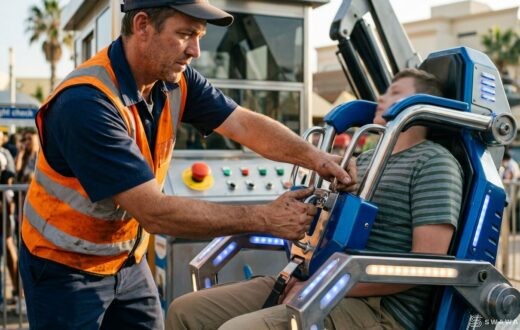
- Cycle every restraint through full close-and-lock, then full open. Every seat, every harness, every belt.
- Verify the lock-confirmation sensor on each seat lights or registers on the operator console.
- Inspect lap bars, over-the-shoulder restraints, and seat belts for fraying, hairline cracks in plastic shells, or worn pivot pins.
- For rides with seat-by-seat sensors, document any seat that took longer than 1 second to register lock; that is an early-failure signal.
5. Lubrication and fluid levels (5 minutes)
- Check engine, gearbox, and hydraulic reservoir levels. Top up only with manufacturer-spec fluid.
- Inspect grease zerks for fresh grease bead (a sign of proper weekly greasing).
- Look at hydraulic hoses and fittings for any sign of weeping fluid; a single drop is the start of a future failure.
- In cold climates, verify the lubricant is correctly winter-rated; we will cover this in detail in the Russia and Central Asia section.
6. Daily test cycle and ride log (5 minutes)
- Run one full ride cycle empty, listening and feeling for any abnormality.
- Run one full cycle with a 70% capacity load using ballast (sandbags or weighted dummies), if the manufacturer protocol requires it.
- Record the test in the ride log: operator name, time, results, anomalies, decision (open / restricted / grounded).
- Sign the log. This signature is your legal and insurance documentation trail.
By-Ride-Category Differences That Matter
The universal six-system checklist covers about 80% of every ride. The remaining 20% is category-specific. Get this wrong and the morning routine looks complete on paper while missing the failure mode that actually closes the ride mid-day.
Trackless train rides
Battery health is the dominant variable. Check state-of-charge before opening, inspect charging-cable insulation, and verify the drive motor and steering actuator respond cleanly. Look at the path sensors and bumper-zone proximity detectors. For trackless train rides operating in malls or pedestrian plazas, sensor calibration drift after winter storage is the most common opening-week issue.
Flying chairs and pendulum rides
Inspect the chain, cable, or tensioned member every single morning. Look for elongation, broken strands, kinks, or corrosion at the anchor points. The drive motor housing, the chair-arm pivot pins, and the seat-belt anchor points are the second-tier inspection. Themed panels on the central tower should be hand-checked for impact damage from windblown debris in outdoor installations.
Carousels
Inspect the central slewing bearing and the platform-to-base seal. Check rotation-motor brushes if applicable. Verify horse-and-figure pivot pins and the manually-operated stopping brake. Lighting is part of the customer experience; a single dark bulb on a 16-seat Lucky Carousel is visible from across a mall corridor.
Bumper cars
Pre-charge the entire fleet overnight and verify each car’s state-of-charge before opening. Check the floor contact strips (if powered) or under-car battery contacts. Inspect every bumper for delamination and every seat for harness function. Bumper cars take the most impact per operating hour of any ride; a daily walk-around catches damage that other ride categories accumulate over weeks.
Spinning and rotating battle ships
Hydraulic pressure check is the dominant daily task. Inspect cylinder rods for scoring, verify fluid clarity, and watch for pressure-gauge drift during the empty test cycle. The slewing ring underneath the platform is the most expensive single component on these rides; any unusual sound from below the deck warrants grounding the ride until inspected.
Cold-Weather and Dust: The Russia and Central Asia Reality
Standard manufacturer maintenance schedules are written for a 22°C indoor showroom or a temperate-climate outdoor park. Russia and Central Asia operators routinely face conditions that no standard schedule contemplates: minus 25°C overnight in Astana, plus 42°C with airborne sand in Termez, voltage sag in a 1970s grid feeder in a Tier 3 Russian city, and a 6,000 km supply chain back to the factory.
These variables do not break the universal checklist. They modify it.
Cold-weather startup protocol
Below 0°C, every drivetrain component is a different metal than the one rated at room temperature. Bearings are slightly contracted, hydraulic fluid is thicker, electrical resistance is up, and rubber seals are stiffer. Starting a ride at full operating speed on a -15°C morning is the single fastest way to age the drive system.
The Swawa cold-start protocol, included in the maintenance log for every ride delivered to a cold-climate market:
- Power on the control system 20 minutes before the first ride cycle. Allow the controller, sensors, and PLC to warm to operating temperature.
- Run the ride empty for 2 full cycles at 60% rated speed before opening to riders.
- Verify hydraulic pressure is within spec at operating temperature, not at startup temperature.
- Check that the winter-grade lubricant rated to your local minimum temperature is in the gearbox. Standard summer-grade gear oil thickens dramatically below 0°C and accelerates gear wear.
- Do not run the ride empty at full speed to “warm it up.” This is the most common operator error in cold climates and the largest single contributor to premature drive-system failure in Russian outdoor parks.
A short story from the field. Murat operates a 5-ride outdoor park in Bishkek that opens daily from late March through October. In 2024, after losing a gearbox on a pendulum ride in his first October cold snap, he rebuilt his morning checklist around the cold-start protocol above. The same ride opened the 2025 season after a -22°C winter with no drive-system damage, and the bearing-wear measurements at the end of the 2025 season were within the same range as a comparable indoor unit.
Dust, sand, and humidity ingress
In sandy or high-dust environments, including outdoor parks across Uzbekistan, southern Kazakhstan, and the Caspian basin, the maintenance variable that matters most is seal integrity. Dust ingress into a bearing reduces its rated life by an order of magnitude.
Operators in dust-prone markets should add three checks to the daily routine:
- Visual inspection of all dust covers and bellows on linear actuators, hydraulic cylinders, and exposed drive components.
- Daily compressed-air or soft-brush cleaning of sensor lenses and limit-switch faces. A sand-coated proximity sensor will eventually fail closed.
- Replacement of air-intake and ventilation filters at twice the manufacturer schedule.
Humid markets such as the Caspian shore and parts of Krasnodar Krai face a different problem: condensation inside control cabinets during temperature swings. Cabinets should be sealed, desiccant packs replaced quarterly, and visual moisture checks added to the daily.
Voltage sag and grid stability
Many Russian and Central Asian operators run on grid feeders that drop voltage during peak load: typically late afternoon on summer weekends, exactly when the rides are most heavily booked. A motor controller that sees a 10% voltage drop for 30 minutes per day accumulates damage that never appears on a daily check but ends the controller two years before its rated life.
The mitigation is straightforward: install a voltage-stabilizing transformer between the grid feeder and the ride control panel. Swawa pre-wires every ride for 220V / 380V at the factory and can specify a voltage tolerance band of plus-or-minus 10% during production, but only if the buyer flags the local grid condition at quote time. A site survey before quote is worth the email.
Operating in Russia, Kazakhstan, Uzbekistan, or Kyrgyzstan? Talk to a Swawa engineer to spec your ride with cold-weather lubricant, winter-rated seals, and a documented voltage tolerance band before production starts.
Mid-Day, End-of-Shift, and Post-Event Routines
The pre-opening checklist is the heaviest single task. The remaining daily routines are short but non-negotiable.
The 4-hour mid-shift walk-around (10 minutes)
Every 4 hours of operating time, the operator should walk a full visual circuit of the ride during a natural break in the queue. Look for new sounds, new vibrations, new debris on the deck, or any rider report of unusual behavior. Restock ticketing supplies. Quick-check restraint operation on three random seats.
The end-of-shift shutdown sequence (10 minutes)
- Run one final empty cycle to confirm clean shutdown.
- Lock the operator console and remove the key.
- Cover or secure exposed components against overnight weather: rain, snow, dew, dust storms.
- Inspect the loading platform for forgotten personal items, debris, or damage.
- Sign the end-of-shift entry in the ride log.
Post-storm and post-event additional checks (15-25 minutes)
After any significant weather event (heavy rain, snow accumulation, high wind, hail, dust storm) or any time the ride is restarted after multi-day closure, add:
- Full structural inspection including all decor panels.
- Check for water ingress in control cabinets and motor housings.
- Verify all sensors and limit switches read correctly through a slow test cycle.
- Document the post-event check in the ride log as a separate entry.
The Weekly, Monthly, Quarterly, and Annual Cadence
Daily checks catch what is wearing. Cadence checks catch what has worn out. The table below is the standard Swawa schedule shipped with every ride, adapted for the higher-cadence requirements of operators in Russia and Central Asia.
| Interval | Focus | Time Budget |
|---|---|---|
| Daily (pre-opening) | 6-system checklist above; ride log signed | 30-45 min |
| Daily (mid-shift and shutdown) | Walk-around + end-of-day routine | 20 min |
| Weekly | Detailed lubrication of all grease zerks; bolt-torque check on critical fasteners; deep-clean of control cabinets | 90-120 min |
| Monthly | Full electrical bonding test; brake-pad / brake-fluid measurement; restraint-system load test (using ballast); replacement of consumable wear parts from Spare Parts Kit | 4-6 hr |
| Quarterly | Hydraulic fluid analysis; bearing-vibration measurement (if instrumentation available); full review of ride log for trend signals | 1 full day |
| Annual | Comprehensive inspection by trained technician; non-destructive testing (NDT) of critical welds; certification renewal where required (EAC / local body) | 2-5 days |
For outdoor parks in Russia and Central Asia, the November-to-March winter closure is the right window for the annual inspection. Many operators front-load the heaviest maintenance into October so the ride is fully serviced before the deep freeze, and lightly re-inspected in March before reopening.
Spare Parts Strategy: 6,000 km from the Factory
This is the section that separates operators in mature markets from operators in Russia and Central Asia. In Western Europe, a wear part is a 48-hour DHL away from any factory. In Bishkek or Khabarovsk, the same part is a 2 to 4 week air-freight plus customs window. The only viable strategy is on-shelf inventory of the parts that are statistically going to wear.
The Swawa Spare Parts Kit
Every Swawa ride ships with a model-specific Spare Parts Kit, sized for approximately 12 months of typical operation. The kit covers about 95% of what a daily checklist will flag for replacement during the first year. It includes bearings, drive belts, fuses, gasket sets, control-board spares in anti-static packaging, consumable hardware, and the specific tools required to install each part.
For operators in our experience, the highest-value kit components in the first year are:
- Sealed bearings for the drive system and platform rotation
- Drive belts or chains, depending on the ride mechanism
- Hydraulic seals and a small reservoir of manufacturer-spec fluid
- Electrical fuses and a spare control-board
- Restraint-mechanism pivot pins and lock-confirmation sensors
Each item in the kit is itemized in the contract by part number. If your contract uses a generic “spare parts package” line, request the itemized version before signing.
How to track wear against your specific traffic
A ride in a high-traffic mall in Almaty wears faster than the same ride in a low-volume outdoor park in eastern Siberia. The Spare Parts Kit assumes typical wear. To match the kit to your reality, log every replacement: which part, which date, which operating hour total. After 6 months, you will see your specific wear curve. Order replenishment parts that match your actual rate, not the generic 12-month assumption.
Bobur operates a 4-ride family entertainment center in a Class-A mall in Tashkent. In his first 8 months of operation, he documented that his pendulum-ride drive-belt wear was running about 35% faster than the manufacturer baseline because the mall’s HVAC kept ambient temperature higher than the typical spec environment. He ordered replenishment belts 4 months ahead of schedule, kept his Spare Parts Kit topped up, and never lost a day of revenue to a belt failure.
When to escalate to the Video Support Center
The Spare Parts Kit handles roughly 95% of what daily maintenance flags. The remaining 5% is what the Video Support Center is for. Escalate any of the following:
- Any structural crack, however small, in a load-bearing component
- Any electrical fault that recurs after a fuse or control-board swap
- Any unexpected change in ride behavior that an operator cannot diagnose on the same day
- Any incident report involving rider injury or near-miss
Video Support responds within 24 hours, in Russian, English, and other partner languages. Most issues are resolved without a site visit. For issues that require on-site engineering, Swawa coordinates dispatch and shipping of any parts outside the kit.
When Daily Maintenance Isn’t Enough: The Failure Triage Workflow
Daily checks are designed to catch the failures you can prevent. The failures you cannot prevent need a different protocol.
First diagnosis: the operator
The operator who runs the morning checklist is also the first line of failure diagnosis. The questions to answer in the first 15 minutes of any unexpected behavior:
- Is the ride safe to operate at restricted capacity, or must it be grounded?
- Is the failure isolated to one component, or is it systemic?
- Is the failure covered by the Spare Parts Kit, or is it outside the kit?
The decision to ground a ride is always the operator’s call. Document the call in the ride log with reason, time, and operator name.
Second opinion: the Video Support Center
Within 24 hours of any grounded ride, the operator should open a Video Support case. Photos, short video clips, and the previous 7 days of ride log entries are the input. The engineer assigned to the case will diagnose remotely, recommend a fix from the Spare Parts Kit if possible, or escalate to a parts shipment or on-site visit.
When to ground a ride and how to communicate it
A grounded ride is a revenue event for the operator and a safety event for the public. Communicate clearly. A printed sign in the local language, a brief explanation to waiting families, a refund or rebooking offer for ticket-holders, and a documented log entry. The cost of a grounded ride for 4 hours is small. The cost of a fatal incident on a ride that should have been grounded is catastrophic.
Operator Training, EAC, and the Documentation Trail
Daily maintenance is only as good as the operator running it. In Russia, Kazakhstan, Belarus, Armenia, and Kyrgyzstan, the regulatory frame is EAC (Eurasian Conformity), and local safety regulators ask to see two things during inspection: the original EAC certificate and the daily ride log.
EAC documentation and the local-language log
The EAC certificate is one-time documentation issued before the ride imports. The ride log is daily, ongoing, and must be in Russian (or the local language as the regulator requires). The log should include:
- Operator name and signature for every daily check
- Time of pre-opening check, mid-shift walk-around, and end-of-shift shutdown
- Any anomaly observed and the corrective action taken
- Every part replaced, with part number from the Spare Parts Kit
- Every Video Support case opened with case number
- Every grounded-ride event with reason and resolution
Swawa provides the ride-log template in Russian, English, and the buyer’s local language at delivery.
Operator certification: NAARSO and regional paths
In the US, NAARSO is the standard operator-certification body. In Russia and Central Asia, there is no single equivalent body, but a few practical paths exist: in-house operator training delivered by Swawa engineers as part of installation, manufacturer-issued certificates of training that satisfy most local regulators, and where regulators require local certification, coordination with the regional safety authority during the EAC documentation cycle.
The most important certification is the one that holds up under regulator inspection. Ask your local body what they require and document accordingly.
The two-operator rule
For safety-critical procedures (restraint testing, brake adjustment, electrical work), enforce a two-operator rule: one performs, one verifies and signs. This is not regulatory in every market. It is best practice in every market.
FAQ: Amusement Ride Daily Maintenance in Russia and Central Asia
How long does daily ride maintenance actually take?
Pre-opening: 30-45 minutes for a single ride, including the six-system checklist and the empty test cycle. Mid-shift walk-around: about 10 minutes every 4 operating hours. End-of-shift shutdown: 10 minutes. Total daily commitment: roughly 60-75 minutes per ride, per operating day.
Who in my team should do the daily checks?
A trained operator. For small parks, this is often the venue owner during the first season; for mid-size parks, a designated head-operator with at least one backup. The two-operator rule applies to safety-critical procedures. Operator training is provided by Swawa engineers during installation for every Swawa ride.
What’s the difference between daily and weekly inspections?
Daily checks catch what is wearing now (loose bolts, weeping seals, sensor drift). Weekly checks catch what has worn (lubrication replenishment, brake-pad measurement, bolt-torque verification). Monthly and quarterly extend the depth further. The cadence table earlier in this guide gives the full schedule.
When should I replace a part vs. lubricate it?
If the part is wearing on a predictable curve and lubrication restores function to spec, lubricate. If the part is at or past 70% of its rated wear, replace it from the Spare Parts Kit and re-order the replenishment. The rule of thumb: lubrication beats replacement for as long as the wear curve allows, but never beyond it.
How do I know if my ride needs a remote-diagnostics call?
Open a Video Support case for any structural crack, any recurring electrical fault, any unexplained change in ride behavior, any rider near-miss, or any ground-the-ride decision. Within 24 hours, the engineer on the case will diagnose remotely and recommend the fix or the next step.
What records do I need to keep for EAC and local safety regulators?
The EAC certificate, the daily ride log signed by the operator, monthly inspection records, quarterly inspection records, annual inspection certificates, every part-replacement entry with part number, every Video Support case, and every grounded-ride event with resolution. Keep records in the local language and store both paper and digital copies.
Your Daily Routine, Your 15-Year Ride
The biggest predictor of how long a ride lasts is not the manufacturer’s spec sheet, and not the country it operates in. It is whether the same trained operator runs the same six-system checklist at the same time every morning, lubricates on schedule, logs every check in a local-language ride log, and escalates to the Video Support Center the moment a fault appears that is not in the Spare Parts Kit.
Lifespan is a discipline, not a purchase.
If you are operating a Swawa ride in Russia, Kazakhstan, Uzbekistan, Kyrgyzstan, or any neighboring market, three actions move you from a 7-10 year ride to a 15-20 year ride starting tomorrow morning:
- Print the six-system daily checklist and post it at the operator console. The most-skipped check is the one that has to be remembered, not the one that is read off paper.
- Audit your Spare Parts Kit against the first 6 months of replacements you have actually made. Replenish what is running ahead of schedule.
- Document everything in Russian or your local language. The EAC certificate plus the ride log is what a regulator wants to see, not the Chinese factory paperwork.
Swawa, the official global brand of Zhongshan Amusement Equipment Industrial Park, has shipped more than 100 rides into 20-plus countries, and the operators who hit year 15 in good condition all do the same things in the morning. They are not the operators with the most expensive rides. They are the operators with the most disciplined routines.
Need a maintenance log template, a Spare Parts Kit audit, or a winter-prep consultation before the next season? Talk to a Swawa engineer or message us on WhatsApp at +8613342997671. For broader buyer questions about ownership, see our frequently asked buyer questions.




 English
  Russian
  Spanish
  Portuguese
  Arabic
  Japanese
  German