
Mall retailtainment in Central Asia turns under-leased floor space into ticketed-entertainment revenue, typically recovering 60-80% of a vacated anchor tenant’s rent within 12-18 months when paired with IP-themed amusement equipment, mobile-foundation installation, and a regionally native logistics plan. The playbook below walks mall operators in Kazakhstan, Uzbekistan, Kyrgyzstan, and the wider CIS through equipment selection, ROI math, customs realities, and after-sales infrastructure.
A mall leasing manager in Almaty doesn’t have a foot-traffic problem. She has a dwell-time problem. Families still walk the corridors on Saturday afternoons. They just don’t stop, don’t spend, and don’t come back during the week. That is the gap retailtainment closes, and the gap Central Asian malls are converting into revenue faster than almost any other region in the world.
If you are weighing whether to fill a vacant department-store anchor with another retail tenant or with a ticketed Family Entertainment Center, this guide gives you the operating math to choose. We will cover the five anchor ride categories that fit Central Asia floor plans, the $180K to $250K equipment budget that produces realistic 12-18 month paybacks, and the Mobile Foundation approach that solves the leased-atrium concrete problem. Along the way, you will see what changes when you contract with Swawa, the official global brand of Zhongshan Amusement Equipment Industrial Park, instead of a trading-company reseller.
Key Takeaways
- Mall retailtainment recovers 60-80% of vacated anchor-tenant rent within 12-18 months when sized for a 400-800 m² entertainment zone in a Class-A or Class-B Central Asian mall.
- The five highest-return mall anchors are trackless trains, IP-themed flying chairs, themed carousels, bumper cars, and compact pendulum or spinning rides; budget $180K-$250K landed for a balanced mix.
- Mobile Foundation Solutions eliminate the concrete-pour blocker that kills most leased-atrium projects, cutting install time by 4-8 weeks and preserving full relocatability when leases change.
- Pre-wired 220V/380V compatibility, Lianyungang-to-Khorgos rail freight, and EAC certification coordination are the three logistics levers that decide whether equipment opens on schedule or sits in Kazakhstan customs.
- The Spare Parts Kit and Video Support Center, both productized by Swawa, are the two service layers that protect after-sales economics in markets 6,000 kilometers from the factory.
What Is Mall Retailtainment, and Why It Matters in Central Asia in 2026
Mall retailtainment is the deliberate replacement of pure-retail floor space with ticketed or experience-driven attractions, designed to extend visitor dwell time and convert foot traffic into paid engagement rather than incidental browsing. In a 2026 Central Asian context, it is also the most effective response to two trends running in opposite directions: the slow rise of regional e-commerce and the rapid expansion of new mall stock across Almaty, Tashkent, Astana, and Bishkek.
The e-commerce gap is real but narrow. Statista’s 2025 e-commerce outlook puts Kazakhstan’s e-commerce penetration at around 12% of retail spend, and Uzbekistan’s at roughly 6%, against EU and US benchmarks of 25% and above. That gives Central Asian malls a longer runway than their Western peers. The pressure point is different: visitors come, but they spend less time per visit, and the rent malls can charge a fashion tenant has plateaued.
Retailtainment closes that gap by replacing per-square-meter rent with per-visitor ticket revenue. Industry research from JLL on the future of retail consistently shows that experience-led mall zones outperform pure-retail floor space on both revenue density and tenant-mix resilience. A 600 m² FEC zone can outperform the same square meters of mid-tier apparel rent within the first operating year, provided the equipment is chosen for footprint, ticket pricing, and the demographic that actually walks the corridor.
The shift from anchor-tenant rent to ticketed-experience revenue
For most of the last 20 years, mall economics in the CIS ran on a familiar template. A department-store anchor paid a discounted rent in exchange for driving traffic to mid-tier line-shop tenants who paid premium rent. When the anchor leaves, that flywheel stalls.
Retailtainment is the replacement flywheel. A well-positioned themed ride or FEC zone generates its own foot traffic, charges its own ticket revenue, and lifts the adjacent food court and family-retail tenants in the process. The leasing math changes from “rent per m²” to “throughput per ride hour.”
The Central Asia Mall Reality: Almaty, Tashkent, Bishkek, and Astana
Class-A malls in Central Asia today have more in common with mid-tier Gulf malls than with their Soviet-era predecessors. MEGA Alma-Ata, Dostyk Plaza, Tashkent City Mall, Compass Mall, Asia Mall in Bishkek, and MEGA Silk Way in Astana all share similar atrium heights, similar power infrastructure, and similar weekend-family-shopper traffic profiles. That homogeneity is good news for retailtainment planners: equipment specified for one mall is usually specifiable for the others.
Demographic snapshot: young families, weekend-as-social-hub
Both Uzbekistan and Kazakhstan have populations where more than 60% of residents are under 35, and weekend mall visits remain a primary form of family entertainment. Cushman & Wakefield’s emerging-markets retail insights consistently flag Central Asia as one of the few global regions where mall foot traffic is still growing year-over-year. This is the operator’s dream demographic: parents with disposable income, multiple children per visit, and weather (cold winters, hot summers) that drives them indoors regardless of season.
Building stock: Soviet-era footprints versus Class-A new builds
Older malls in the region carry constraints worth flagging early. Ceiling heights in some converted Soviet-era buildings drop below 4.5 meters, which disqualifies most pendulum and tall spinning rides. Newer Class-A malls typically clear 6-8 meters in atriums, which opens up the full Swawa StarCore Agents™ lineup. The first site question should always be: what is the atrium clear height, and where is the structural load capacity?
Climate and power realities
Winter HVAC load is the operational variable most often missed. A themed ride that spins comfortably in a 22°C atrium needs different lubricant and electrical specs than one operating in a 14°C corridor. Voltage stability is a second variable: Almaty and Astana run mostly on stable 220V single-phase and 380V three-phase, but voltage sag during winter peak load is common in older buildings. Specify your equipment with a voltage tolerance band, not a fixed input.
Customs and logistics
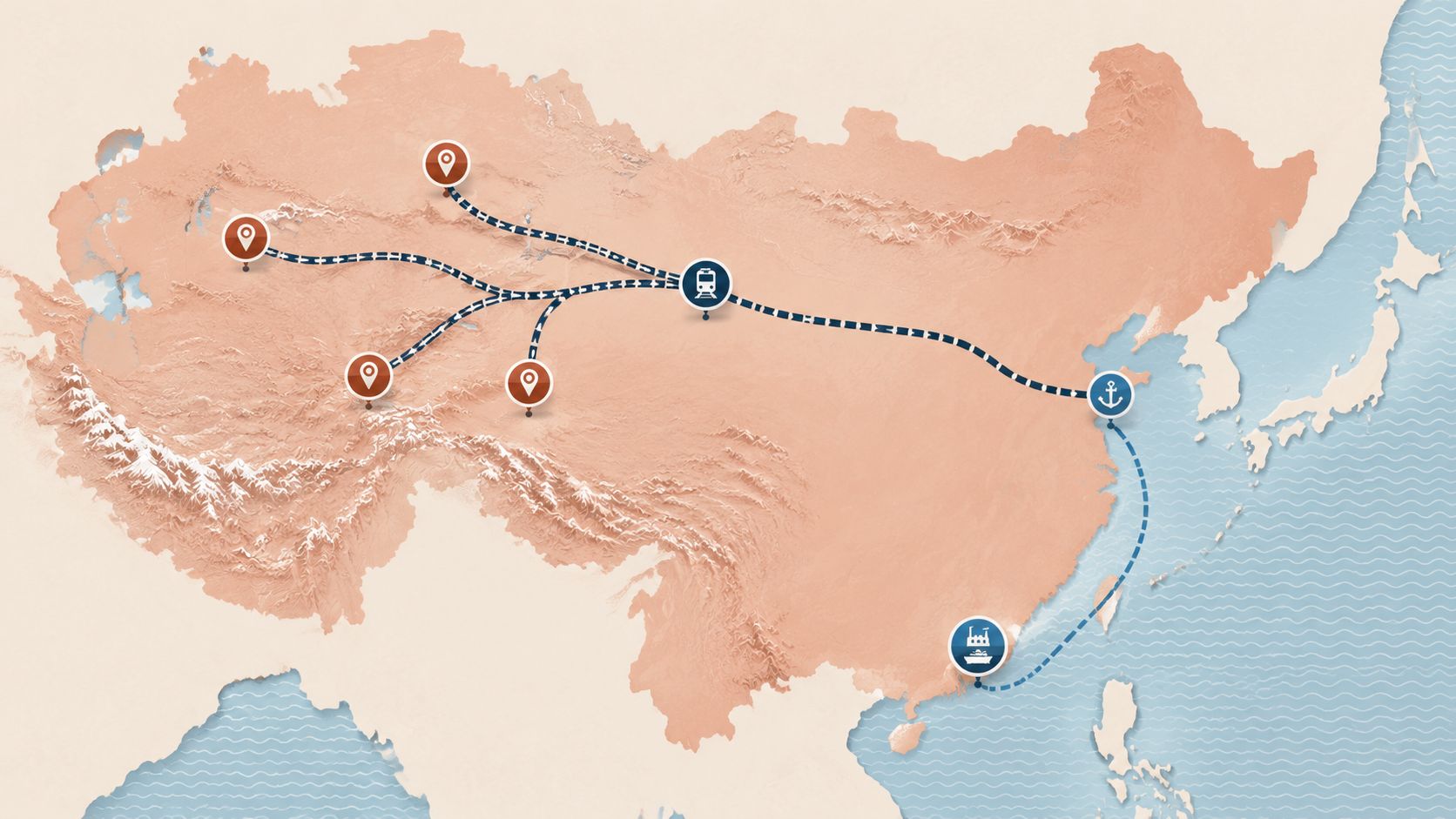
The dominant freight route from southern China to Central Asia is sea-and-rail: container loading at Lianyungang, rail through the Khorgos dry port, and last-mile truck or rail to Almaty, Tashkent, or Bishkek. Total transit time runs 18-28 days depending on Khorgos throughput. EAC (Eurasian Conformity) certification is the documentation hurdle most first-time importers underestimate, and it must be coordinated during production, not at the port.
Five Retailtainment Anchors That Work in Central Asia Malls
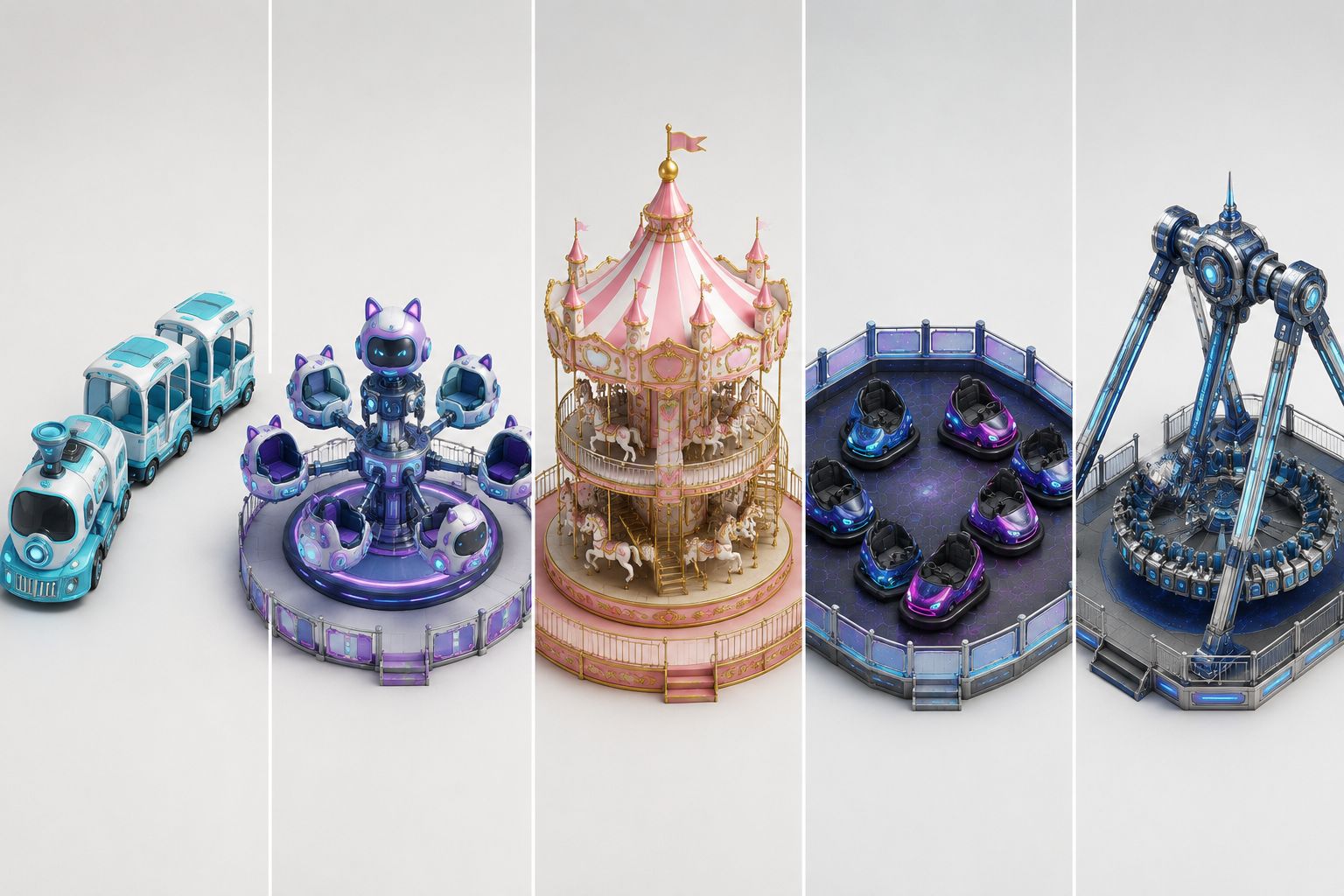
Not every ride built for an outdoor theme park belongs in a mall. The five categories below cover roughly 90% of the indoor mall retailtainment installations Swawa ships into the region. Each was selected for footprint, ceiling clearance, power profile, and ticket economics. Industry data from IAAPA on themed attractions consistently shows IP-themed rides extend visitor dwell time by 40-60% over generic equipment, which is the underlying reason the StarCore Agents™ universe outperforms catalog rides at the same price point.
For an operator working through this list with a real floor plan, the shopping mall amusement equipment catalog on amuse-mfg.com shows specific models with footprint and voltage data.
Trackless trains for mall corridors and atrium circulation
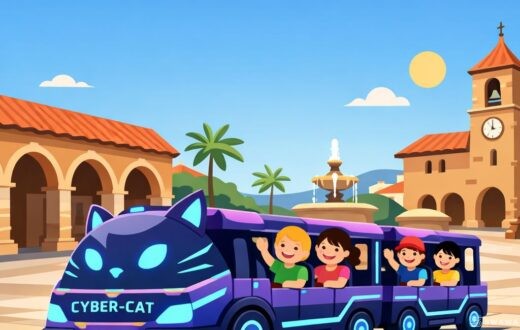
Battery-operated, infrastructure-free, and the easiest first ride to commission. A trackless train turns dead corridor space into ticketed circulation, hits an attractive ticket price point ($2-$4 per rider), and drives parents past adjacent food and retail tenants on every loop. Swawa’s trackless train rides catalog includes the Cyber-Cat Electric Trackless Train and the Sci-Fi Electric Trackless Train, both engineered for 220V indoor charging and quiet mall operation.
IP-themed flying chairs as anchor moments
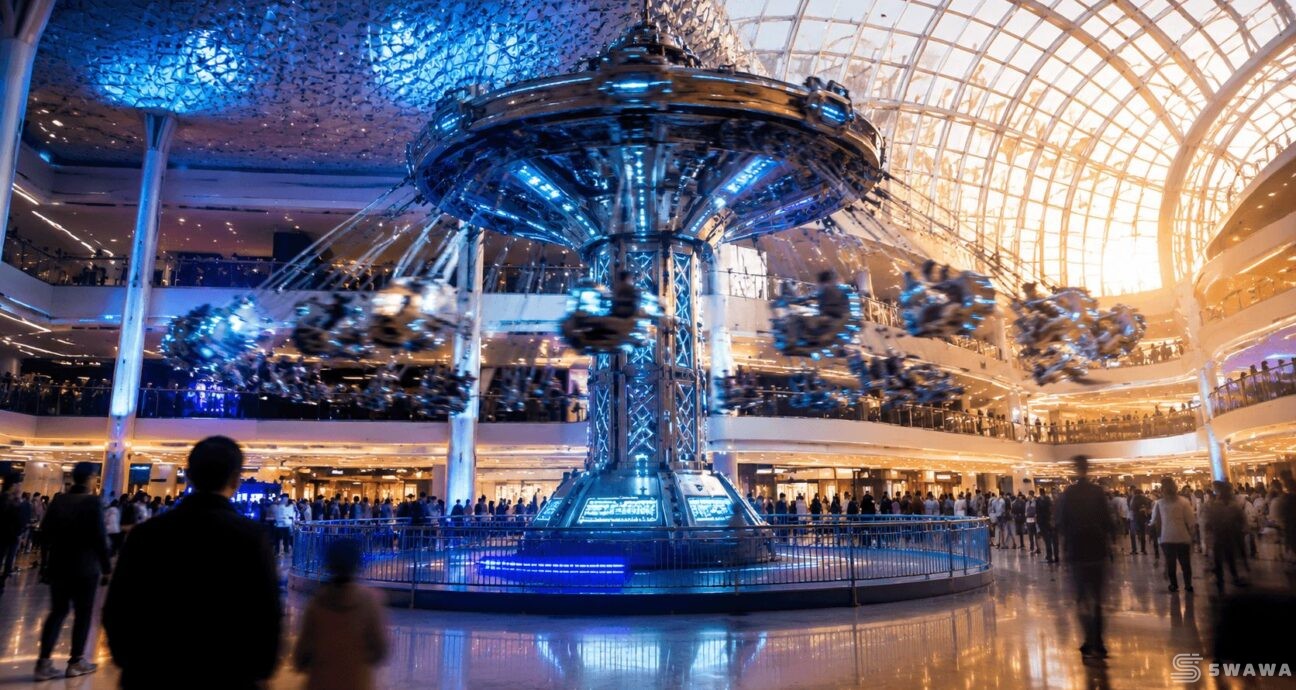
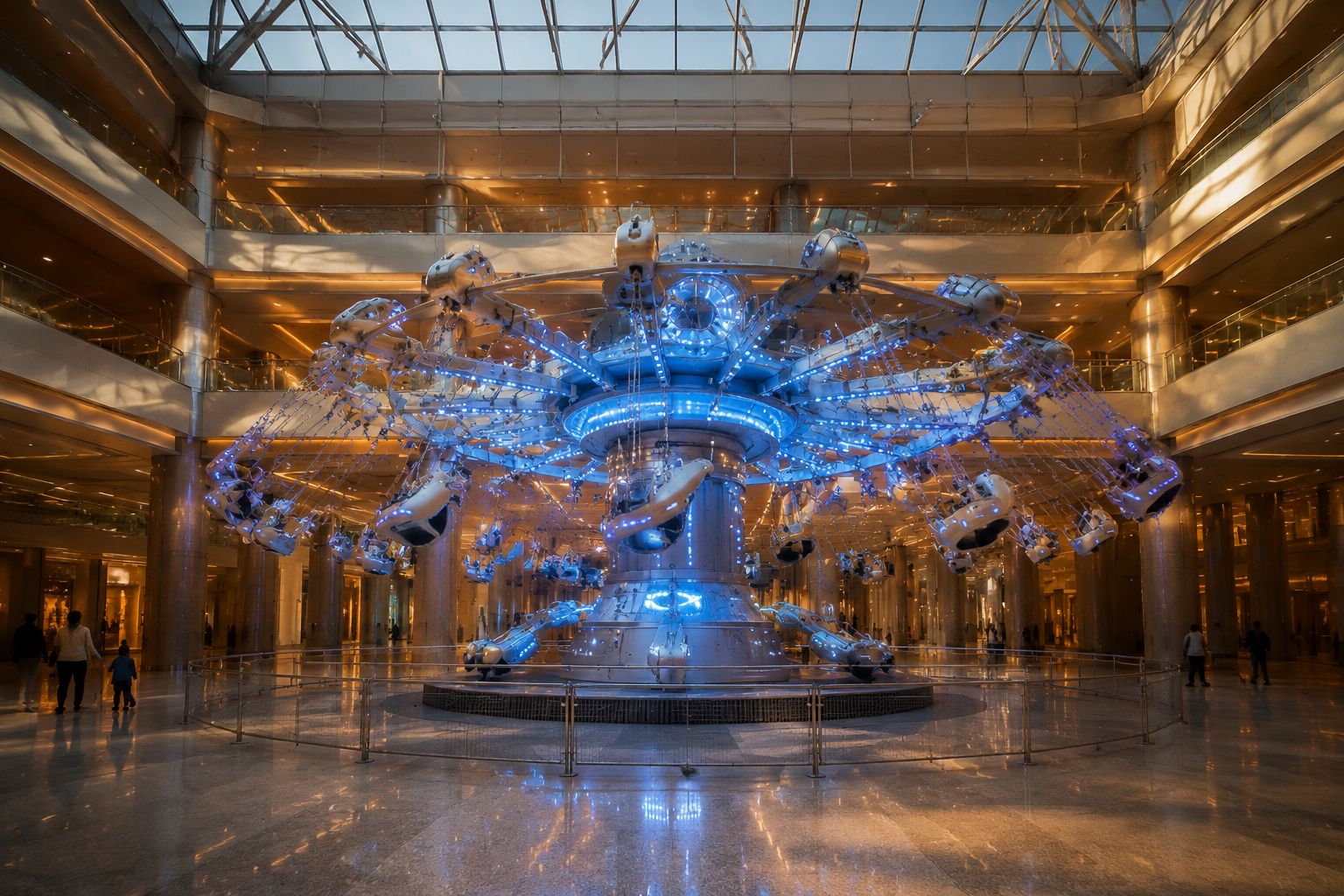
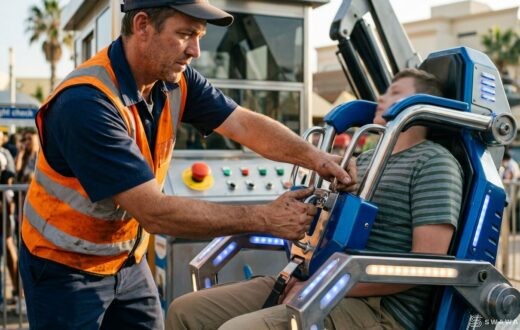
The 36-Seat Sci-Fi “Nuclear Crisis” Flying Chair from the StarCore Agents™ universe is the flagship mall anchor where ceiling height allows. It is photo-worthy, generates social-media-driven foot traffic, and supports premium ticket pricing ($4-$6) because visitors are buying a themed experience, not a generic swing ride. Footprint runs around 12 meters in diameter with 7-8 meters of clear height.
For malls without that vertical clearance, smaller themed ride options in the StarCore Agents™ Ready-to-Ship Collection include the 6-Person Cyber-Cat Jumping Ride and the Catnip Knight Futuristic Motorcycle Carousel.
Themed carousels: low-noise, low-voltage, all-ages monetization
The Lucky Carousel and similar themed merry-go-rounds are the workhorse of mall retailtainment. They suit a 6-8 meter diameter footprint, run on 220V, generate near-zero noise complaints from adjacent retail tenants, and capture the youngest age bracket (ages 3-7) that parents reliably pay for. Carousel utilization in mall settings often exceeds 60% of operating hours on weekends.
Bumper cars in compact zones
A 6-12 car bumper car zone occupies 80-150 m² and delivers the highest per-square-meter throughput of any standard mall ride. The 2-Seater Cyber-Cat Bumper Car and Galaxy Themed Bumper Cars run on low-voltage internal battery systems, meaning no embedded floor wiring. Ticket pricing ($3-$5 for a 3-minute round) and the high repeat-ride rate from teens and tweens make it the strongest secondary anchor in most installations.
Mecha pendulum and spinning rides for teen ticket premium
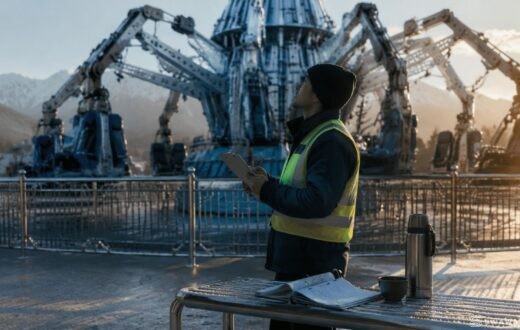
Where atrium height and floor load permit, the 20-Person Mecha Style Pendulum Ride or the 16-Person Alien Invasion Rotating Battle Ship pulls in the teen and young-adult demographic that the other four anchors do not reach. These rides justify the highest ticket prices ($5-$8) and create the social-media moments that drive weekday return visits.
See the StarCore Agents™ Sci-Fi “Nuclear Crisis” Flying Chair in operation:
The Mobile Foundation Advantage for Leased Mall Space
Most Central Asia retailtainment projects involve leased atriums, not owned floor plates. Mall operators rarely have the authority or the timeline to pour permanent concrete foundations for amusement equipment, and even when they do, the permit process can run 4-8 weeks against a renovation that needs to open before the next holiday quarter.
This is the single biggest reason first-time mall retailtainment projects stall. The supplier ships a beautiful ride to Almaty, and it sits in a warehouse while the mall renegotiates structural and electrical permits with the building authority.
How Mobile Foundation Solutions work
Swawa’s Mobile Foundation Solutions replace the permanent concrete pour with an engineered steel-and-counterweight base system. The base is sized to the ride’s dynamic load profile, level-adjusted on the existing mall floor, and bolted with non-permanent floor anchors that the mall’s facility team can certify against the building’s existing slab specifications. No new pour. No structural permit. No four-week wait.
In practical terms, this turns a 6-8 week installation timeline into a 7-14 day timeline. It also makes the ride fully relocatable. If the mall reorganizes its tenant mix two years from now, or if the operator opens a second venue, the ride moves with them.
What you save
The economics are straightforward. Eliminating the concrete pour removes roughly $8K-$20K of foundation cost, 4-8 weeks of installation delay, and the permitting risk that the building authority simply says no. Across 100-plus mall installations, Swawa’s data shows that Mobile Foundation projects open on schedule at roughly twice the rate of permanent-foundation projects.
The Real ROI Math: A Sample Renovation in a 5,000 m² Almaty Mall
The fastest way to make this guide useful is to walk through a representative scenario. The numbers below are illustrative, drawn from typical Swawa equipment pricing and plausible Almaty mall economics. They are not a guarantee. Your specific result depends on your traffic, ticket pricing, operating days, and labor cost, but the framework is the one we use in 3D site renderings for prospective clients.
The setup
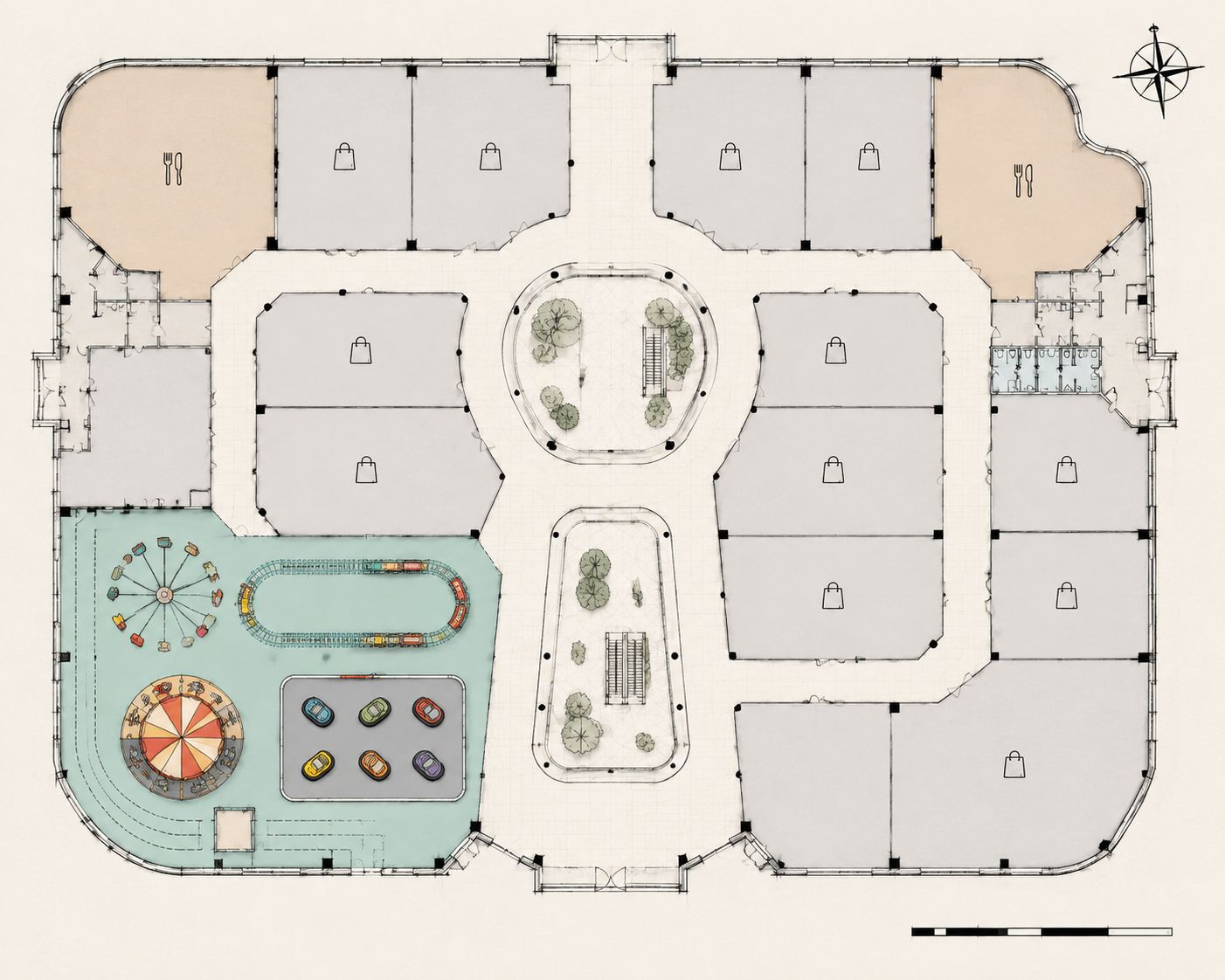
Aigerim manages a 5,000 m² Class-B mall in southwestern Almaty. A mid-tier fashion anchor vacated 800 m² in late 2025. Adjacent line-shop tenants are still paying rent, but Saturday foot traffic has dropped 18% in the six months since the anchor left. She has approval to convert 600 m² of the vacated space into a Family Entertainment Center, with 200 m² reserved for a complementary food-and-beverage operator.
Equipment mix
She specifies a four-ride mix, all on Mobile Foundation, all pre-wired for 380V three-phase:
- 1 × Cyber-Cat Electric Trackless Train (mall corridor circulation, 40 m² parking footprint)
- 1 × StarCore Agents™ 6-Person Cyber-Cat Jumping Ride (anchor moment, 60 m²)
- 1 × Lucky Carousel 16-Seat themed merry-go-round (workhorse, 80 m²)
- 1 × 6-car Galaxy Themed Bumper Car zone (secondary anchor, 120 m²)
The remaining 300 m² hold ticketing, queuing, theming decor, and a small photo zone.
Investment
| Line Item | Cost (USD) |
|---|---|
| Equipment (factory-direct, Spare Parts Kits included) | $145,000 |
| Sea freight Lianyungang to Almaty (Khorgos rail) | $18,000 |
| EAC certification coordination and customs | $9,000 |
| On-site installation and commissioning (7-10 days) | $14,000 |
| Theming, signage, photo zone decor | $22,000 |
| Ticketing, queuing, soft costs | $12,000 |
| Total landed and operating-ready | $220,000 |
Revenue model
Conservative weekday-and-weekend traffic blend:
- 250 average rider transactions per day
- $3.00 average ticket price (blended across the four rides)
- 320 operating days per year (accounting for holidays and slow weekdays)
- Annual gross revenue: 250 × $3 × 320 = $240,000
After operating costs (3 staff, electricity, maintenance, lease share of common area), net margin runs 55-65% in a Central Asian labor market, producing roughly $130K-$155K in annual net cash flow.
Payback
At the conservative end, payback runs roughly 17 months. With weekend-driven traffic uplift (Saturdays in Almaty malls typically run 2-3x weekday volume) and holiday peaks, most operators in this scenario clear payback inside 12-14 months.
The takeaway: a $220K investment, made on a 600 m² floor plate, replaces and exceeds the rent the vacated anchor was producing, while lifting adjacent tenants’ foot traffic.
Ready to model your own venue? Send Swawa your mall floor plan and we will return a free 3D site rendering and detailed quote within 5 business days. Request your 3D rendering →
Logistics, Customs, and Voltage: The Belt-and-Road Native Checklist
The execution gap between a retailtainment project that opens on time and one that misses two quarters comes down to four logistics levers. Each looks small in isolation. Together they are the difference between a flywheel and a parked container.
Freight route
Sea freight from Guangdong to Lianyungang port, rail through Khorgos, and last-mile truck or rail to your city. Total transit runs 18-28 days. For Tashkent and Bishkek, last-mile rail is typically faster than truck. For Almaty and Astana, both options are viable. Swawa’s global installation and after-sales support coordinates the full route, including customs broker handoff at the Kazakhstan border.
EAC certification
The Eurasian Economic Union’s EAC mark is mandatory for amusement equipment entering Russia, Kazakhstan, Kyrgyzstan, Armenia, and Belarus. The certification must be issued by an accredited body before the goods clear customs. Swawa coordinates EAC documentation during production, not after the goods land. Coordinating EAC after shipment is the single most common cause of multi-week customs holds.
Voltage specification
Specify 220V single-phase or 380V three-phase at quote time. Swawa pre-wires every ride at the factory to the buyer’s confirmed voltage. Where the mall has voltage instability (common in older buildings), specify a voltage tolerance band of plus-or-minus 10%, which Swawa engineers can configure during production.
Climate adaptation
Cold-weather assembly during winter installs in Astana or Bishkek calls for low-temperature-rated lubricants and gasket materials. Specify this at quote, not on site. The cost difference is marginal. The reliability difference is significant.
After-Sales Reality: What Happens When a Part Fails in Bishkek?
Six months into operation, something breaks. This is not pessimism. It is operating reality. The question is not whether a wear part will need replacement. The question is what the operator does on the day it happens.
Bobur, a Tashkent investor who opened a 4-ride FEC zone in a Class-A mall in 2024, made his ride choice partly on after-sales infrastructure. In month seven, the drive motor on his pendulum ride showed bearing wear. He opened the Spare Parts Kit shipped in the original container, pulled the replacement bearing assembly, video-called Swawa’s Video Support Center the next morning, and was back in operation by the end of the same day. The total downtime was less than 24 hours, and the cost was zero on top of the original equipment purchase.
That outcome is engineered. It is not luck.
The Spare Parts Kit
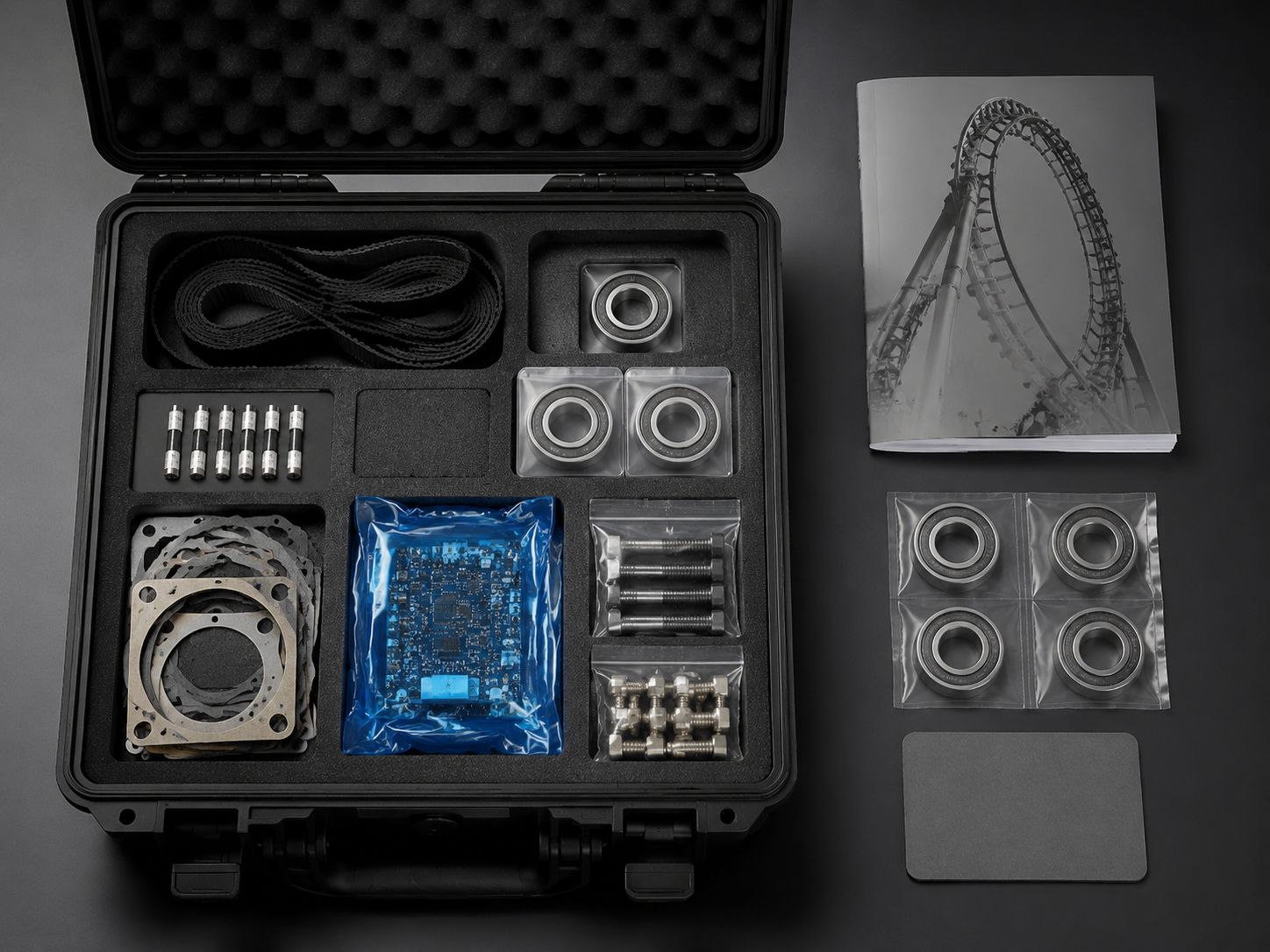
Every Swawa ride ships with a model-specific Spare Parts Kit sized for roughly 12 months of operation, covering the parts most likely to wear or fail during the first year. The kit is matched to the ride during pre-shipment QA, not pulled from a generic catalog. Bearings, belts, fuses, control-board spares, gasket sets, and consumable hardware are all included.
For overseas buyers, this single decision eliminates the worst after-sales scenario in the industry: a critical ride down for three weeks while a part air-freights from China.
The Video Support Center
The second layer is the Video Support Center, a productized remote-diagnostics service that responds within 24 hours in multiple languages. Most issues are resolved via video walk-through without a site visit. For more complex repairs, Swawa engineers coordinate the right part, the right tool list, and the right local technician.
When a site visit is actually needed
For the small percentage of issues that require on-site engineering support, Swawa dispatches engineers globally. The Belt-and-Road footprint, with installations across Central Asia, the Middle East, Russia, and Southeast Asia, means most regions have a logistically viable response window of 5-10 days.
How to Choose a Manufacturer for a Central Asia Mall Project
If you take only one section away from this guide, take this one. The cost of choosing the wrong supplier in Central Asia is rarely the equipment price. It is the lost first season.
Factory-direct versus trader: four contract clauses to check
When evaluating quotes, look for these four clauses:
- The contracting party. Are you signing with the factory itself, or with a Hong Kong trading shell that subcontracts to a factory you cannot visit? Swawa contracts are with the Zhongshan Amusement Equipment Industrial Park entity directly.
- IP ownership. Is the themed ride built on the manufacturer’s own IP, or on a third-party licensed IP that could expire or trigger royalty disputes? Swawa’s StarCore Agents™ and Meow Nuclear universes are in-house, patent-backed, and royalty-free for the buyer.
- Spare Parts Kit specification. Is the parts kit itemized in the contract by part number, or is it a vague “spare parts package” line item? Demand part-numbered itemization.
- After-sales response time. Is the response window in the contract, or is it a marketing claim? Swawa’s Video Support Center 24-hour response window is contractual.
Patents, delivery track record, and the visit-the-factory test
Swawa operates as the official global brand of Zhongshan Amusement Equipment Industrial Park, with 100-plus rides delivered across 20-plus countries, 10-plus design patents, and a visitable production facility in Guangdong. For Central Asia projects of any meaningful scale, a pre-purchase factory visit is recommended. It is the single best test of supplier credibility.
For larger venue projects involving multiple rides plus theming and decor, the Turnkey IP Theme Park Solution bundles design, manufacturing, installation, and operator training into a single accountable contract.
FAQ: Central Asia Mall Retailtainment
How much floor space do I need for a mall Family Entertainment Center?
A workable mall FEC starts at around 400 m² for a 2-3 ride mix and scales to 800-1,200 m² for a 4-5 ride mix with theming and ticketing. The most common size in current Central Asian projects is the 600 m² four-ride layout described in the ROI section above.
What’s the typical payback period for mall amusement equipment in Kazakhstan?
For a $180K-$250K landed investment in a 600 m² layout, payback typically runs 12-18 months. The conservative model is 17 months; the weekend-traffic-driven model is 12-14 months. The exact figure depends on local ticket pricing, foot traffic, and operating days.
Can I install amusement rides without pouring concrete in a leased mall space?
Yes. Mobile Foundation Solutions replace permanent concrete pours with engineered steel base systems that bolt to the existing mall slab using non-permanent anchors. This is the standard approach for leased atrium installations across Central Asia.
What voltage do Central Asian malls run on?
Most malls in Kazakhstan, Uzbekistan, and Kyrgyzstan operate on 220V single-phase for smaller equipment and 380V three-phase for larger rides. Both are standard on Swawa equipment, pre-wired at the factory once the buyer confirms the local specification.
How long from order to opening day?
For Ready-to-Ship Collection equipment, 8-12 weeks total: 2-4 weeks production, 3-4 weeks freight (Lianyungang to Khorgos to your city), 1-2 weeks customs clearance, and 7-14 days installation. For custom OEM and ODM builds, add 4-6 weeks to production.
How do I get amusement equipment through Kazakhstan customs?
The two requirements are valid EAC certification issued before shipment and complete commercial documentation matching the ride’s HS code. Swawa coordinates EAC certification during production and provides the full customs document set, which dramatically shortens the typical port-of-entry hold.
Your Next 3 Steps to a Ticketed Mall Floor
Murat operates a 7-ride FEC in a Bishkek mall that he opened in early 2024. When asked what he would do differently, his answer was specific: start the 3D site rendering and EAC documentation earlier. The equipment is the easy part. The site fit and the customs paperwork are what compress a six-month project into a three-month one.
If you are evaluating a Central Asia mall retailtainment project, three actions move you from research to revenue:
- Send your floor plan to Swawa. A photo, a sketch, or a CAD file is enough. We return a free 3D site rendering and a budget quote within 5 business days, with no commitment required.
- Confirm your local voltage and EAC requirements. This is the single fastest way to compress your timeline by 4-6 weeks.
- Specify your Spare Parts Kit and Video Support Center coverage in the contract. Productized after-sales is the difference between a confident year-one operation and an emergency-airfreight scramble.
Retailtainment is no longer an experiment in Central Asia. It is a measurable category, supported by patent-backed IP, mobile-foundation installation, and after-sales infrastructure that lands in the same container as the ride. The mall floor that used to pay anchor-tenant rent can now print ticket revenue. The question is whether you build the flywheel for your venue in 2026, or watch the next mall do it first.
Start your project today. Request a 3D site rendering and quote, or talk to a Swawa engineer on WhatsApp at +8613342997671. For larger multi-ride venues, explore the Turnkey IP Theme Park Solution.
 English
  Russian
  Spanish
  Portuguese
  Arabic
  Japanese
  German